Trisodium citrate in detergent production plays an important role in improving cleaning performance, softening hard water, and supporting the development of more environmentally friendly detergent formulations. This compound is widely used as a builder and chelating agent because it can bind metal ions, particularly calcium and magnesium, which are commonly found in hard water.
By reducing the effects of hard water, trisodium citrate helps detergents work more effectively and supports the performance of surfactants. It can also serve as an alternative to certain phosphate-based ingredients in detergent formulations.
In this article, we explore the properties, functions, and seven key applications and benefits of trisodium citrate in the detergent industry.
1. What Is Trisodium Citrate?
Trisodium citrate, also known as sodium citrate, is the sodium salt of citric acid. It is commonly available in anhydrous and dihydrate forms and is used in various industrial applications, including food processing, pharmaceuticals, and household cleaning products.
In detergent formulations, trisodium citrate is primarily used as a builder and chelating agent. Its ability to bind metal ions makes it particularly useful in products designed to clean effectively in hard water conditions.
Unlike some traditional detergent builders, trisodium citrate can offer a phosphate-free formulation option, making it a useful ingredient for manufacturers seeking to reduce the use of phosphate-based compounds.
2. Seven Key Applications and Benefits of Trisodium Citrate in Detergent Production
Trisodium citrate provides several functional benefits in detergent formulations. Its main applications include the following:
1. Softening Hard Water
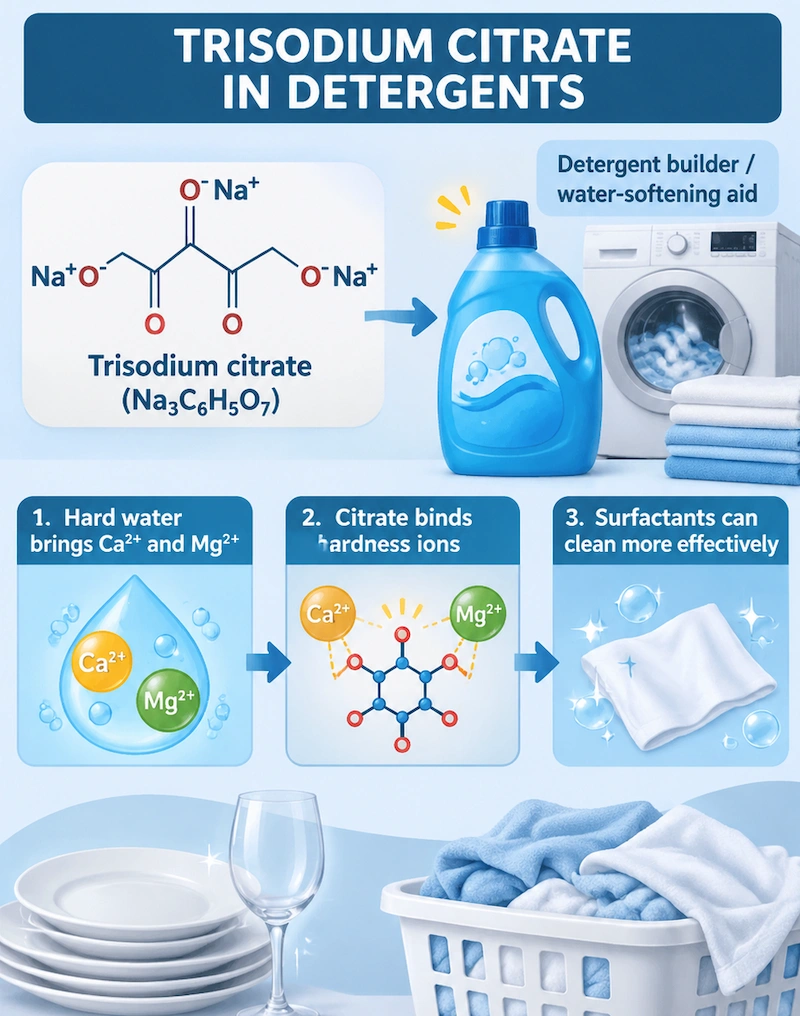
One of the most important functions of trisodium citrate is water softening. Hard water contains dissolved minerals, especially calcium and magnesium ions, which can interfere with detergent performance.
Trisodium citrate binds these metal ions and reduces their interference with the cleaning process. As a result, detergents can perform more effectively under hard water conditions.
2. Improving Surfactant Performance
Surfactants are essential ingredients in detergents because they help remove grease, oils, and dirt from different surfaces.
However, calcium and magnesium ions in hard water can reduce the effectiveness of certain surfactants. By binding these ions, trisodium citrate helps maintain more favorable conditions for surfactant activity and supports overall cleaning performance.
3. Reducing the Need for Phosphate-Based Builders
Phosphates have traditionally been used in detergent formulations to soften water and improve cleaning performance. However, concerns about their environmental impact have encouraged manufacturers to consider alternative ingredients.
Trisodium citrate can be used as a builder in some phosphate-reduced or phosphate-free detergent formulations. Its suitability depends on the product formulation, cleaning requirements, and applicable regulations.
4. Supporting Soil Removal and Preventing Redeposition
During washing, dirt and other contaminants are released from fabrics and surfaces into the cleaning solution. If these particles are not adequately dispersed, some of them may settle back onto the cleaned material.
By helping control metal ions in the washing solution, trisodium citrate can contribute to better detergent performance and support the overall cleaning process. Its effectiveness in preventing redeposition also depends on the other ingredients in the formulation.
5. Application in Liquid and Gel Detergents
Trisodium citrate can be incorporated into different types of detergent products, including liquid and gel formulations.
In these products, it functions as a builder and chelating agent, helping manage the effects of hard water and supporting cleaning performance. The appropriate concentration depends on the formulation, the hardness of the water, and the intended application.
6. Use in Detergent Powders and Tablets
Trisodium citrate is also used in powdered and tablet detergent formulations.
In these products, it helps control the effects of calcium and magnesium ions and contributes to the overall performance of the detergent. Its compatibility with other formulation ingredients makes it a useful component in different types of cleaning products.
7. Improving the Properties of Detergent Tablets
Anhydrous trisodium citrate can have additional formulation benefits in detergent tablets.
It may be used as a carrier for certain liquid surfactants, helping incorporate liquid ingredients into solid detergent systems. Depending on the formulation, it can also contribute to the physical properties and handling characteristics of detergent tablets.
3. How Does Trisodium Citrate Work in Detergents?
The main mechanism behind the use of trisodium citrate in detergent production is its ability to form complexes with metal ions.
Hard water contains calcium and magnesium ions. These ions can interact with detergent ingredients and reduce the effectiveness of the cleaning process.
When trisodium citrate is added to a detergent formulation, citrate ions can bind calcium and magnesium ions, reducing their availability to interfere with other ingredients.
This process helps:
Reduce the negative effects of hard water.
Support surfactant performance.
Improve the overall efficiency of detergent formulations.
Provide an alternative builder option in certain phosphate-free products.
The actual performance of trisodium citrate depends on factors such as water hardness, product composition, pH, and the concentration of the ingredient.
4. Environmental Benefits of Trisodium Citrate
4. Environmental Benefits of Trisodium Citrate
Environmental considerations are increasingly important in the detergent industry. Manufacturers are looking for ingredients that can help reduce the environmental impact of cleaning products without compromising their performance.
Trisodium citrate is considered a useful option in this area for several reasons:
Biodegradability: Citrate-based compounds can undergo biodegradation under suitable environmental conditions.
Phosphate reduction: It can replace or reduce the need for certain phosphate-based builders in suitable formulations.
Formulation flexibility: It can be used in different detergent types, allowing manufacturers to develop alternative cleaning formulations.
However, the overall environmental impact of a detergent depends on its complete formulation, production process, dosage, and disposal conditions—not on a single ingredient alone.
5. Important Considerations When Using Trisodium Citrate
Although trisodium citrate offers several benefits, selecting the right grade and concentration is important for achieving the desired results.
Detergent manufacturers should consider the following factors:
Product grade: Choose a grade suitable for the intended industrial application.
Physical form: Determine whether anhydrous or dihydrate trisodium citrate is more appropriate for the formulation.
Water hardness: Consider the concentration of calcium and magnesium ions in the water used during washing.
Formulation compatibility: Evaluate how trisodium citrate interacts with surfactants, enzymes, builders, and other detergent ingredients.
Dosage optimization: Determine the appropriate amount through formulation testing rather than relying on a universal dosage.
Laboratory testing and formulation trials are recommended to evaluate the performance and compatibility of trisodium citrate in each specific detergent product.
6. Conclusion
Trisodium citrate is a versatile ingredient in the detergent industry, mainly because of its ability to bind calcium and magnesium ions and reduce the effects of hard water.
Its applications include water softening, supporting surfactant performance, reducing reliance on phosphate-based builders, and use in liquid, gel, powder, and tablet detergents.
In addition, its biodegradability and suitability for certain phosphate-free formulations make it a valuable option for manufacturers developing more environmentally conscious cleaning products.
Choosing the appropriate grade and concentration, along with evaluating compatibility with other ingredients, is essential to achieving the best results in detergent production.