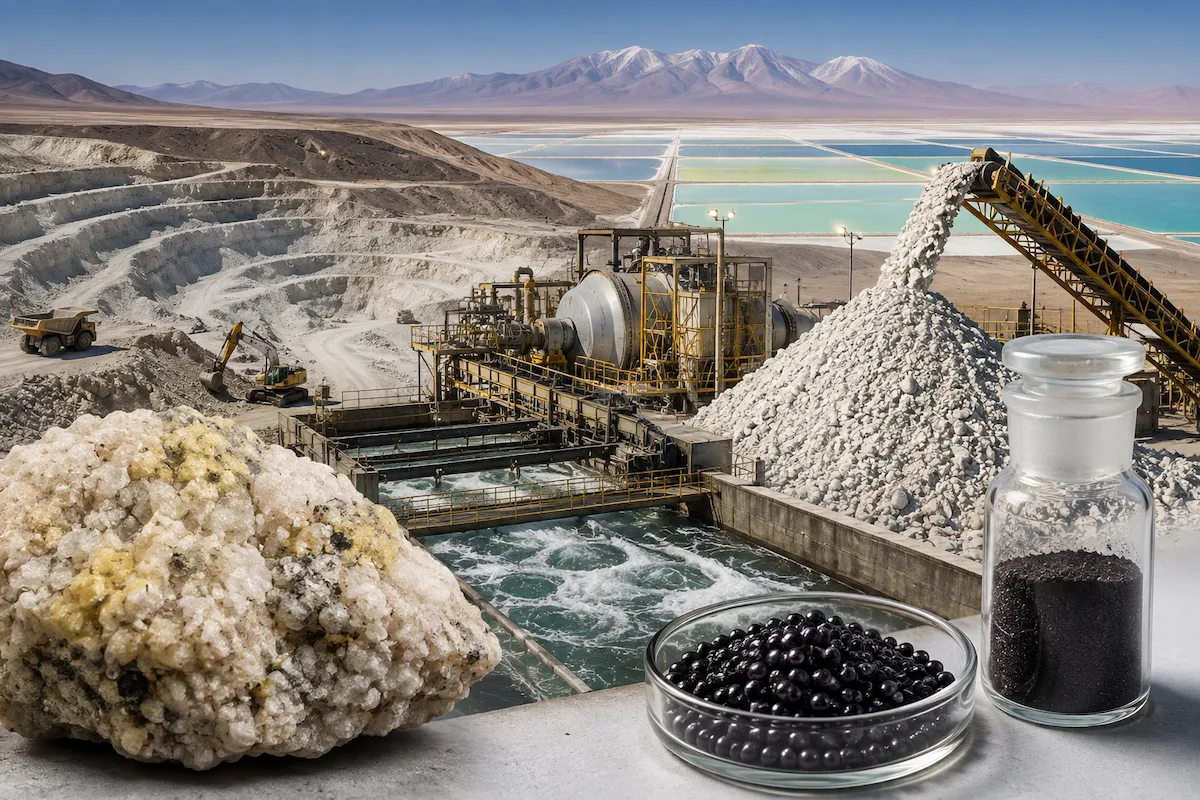
Iodine production in Chile supplies a significant share of the global iodine market. Unlike countries such as Japan and the United States, which primarily extract iodine from underground brines, Chile relies mainly on solid mineral deposits in the Atacama Desert as its primary source of iodine production.
In this process, iodate compounds present in the ore are converted into elemental iodine through chemical reactions following extraction and leaching, and are then purified.
In the following sections, we will explore iodine-bearing minerals, the 7 stages of iodine production, major production centers, and the environmental challenges associated with this process.
How Is Iodine Produced in Chile?
Chile’s iodine mineral reserves are mainly located in the northern regions of the country, particularly Tarapacá and Antofagasta. The iodine in these deposits is found primarily in the form of iodate compounds.
At processing plants, the ore is first extracted and then subjected to leaching, which transfers its soluble compounds into the aqueous phase. Through a series of oxidation–reduction reactions, iodate is converted into iodide and subsequently into molecular iodine.
The overall process involves extraction, leaching, solution preparation, chemical reactions, purification, and final product production.
What Is Caliche?
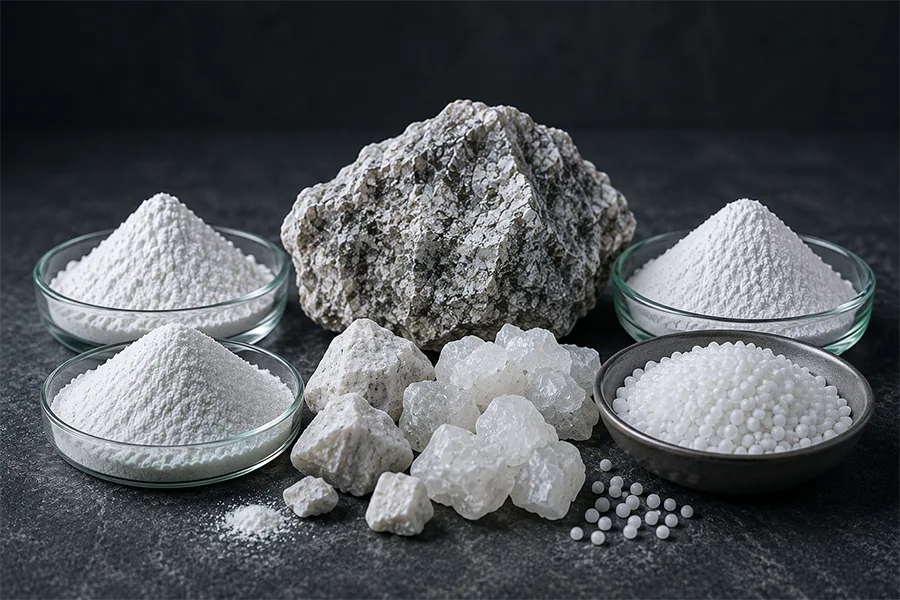
Caliche is a salt-rich evaporite ore formed in the arid environment of the Atacama Desert. It is one of the main mineral resources used by the chemical industry in northern Chile.
The iodine content of caliche is relatively low, typically ranging from a few hundred ppm. Despite this low concentration, the large size of the deposits and the feasibility of industrial processing have made caliche an important mineral resource for commercial iodine production.
Iodine-Bearing Minerals in Caliche
Iodine in these deposits is found primarily in the form of iodate compounds and in minerals such as lautarite and dietzeite.
Lautarite
Lautarite is one of the important iodine-bearing minerals, with the following chemical formula:
Ca(IO₃)₂
This mineral contains calcium iodate and plays a role in the iodine extraction process.
Dietzeite
Dietzeite is another iodine-bearing mineral found in these deposits. In addition to iodate compounds, it also contains calcium chromate.
Variations in the mineralogical composition of different parts of the ore are among the factors that must be considered when designing and controlling the processing process.
7 Stages of Iodine Production from Caliche
The industrial production of iodine from caliche can be divided into seven main stages.
1.Ore Extraction
The ore is extracted from surface deposits in northern Chile and transported to processing facilities after loading.
The purpose of this stage is to prepare the raw material for extracting soluble compounds in the subsequent stages.
2.Ore Leaching
In the leaching process, water or a suitable solution is passed through the ore to dissolve soluble compounds, including iodates, into the solution.
One of the methods used is heap leaching, in which the ore is stacked on designated beds and the solution is passed through it. In some processing routes, vat leaching is also used.
3.Iodate Solution Preparation
The solution obtained from leaching contains iodates and other soluble compounds. At this stage, the solution conditions are adjusted to facilitate the subsequent chemical reactions.
4.Conversion of Iodate to Iodide
Part of the iodate in the solution is converted to iodide using a reducing agent such as sulfur dioxide (SO₂).
As a result, the iodate ion IO₃⁻ is converted into the iodide ion I⁻. The resulting iodide is then used in the next stage to produce molecular iodine.
5.Production of Elemental Iodine
The iodide-containing solution reacts with another portion of the iodate solution under acidic conditions:
5I⁻ + IO₃⁻ + 6H⁺ → 3I₂ + 3H₂O
In this reaction, iodide is oxidized and iodate is reduced, forming molecular iodine (I₂).
In this way, iodine is converted from its ionic form into a recoverable form.
6.Purification and Concentration
The iodine produced must be separated from other compounds present in the process stream. Depending on the design of the industrial facility, various separation and concentration steps are used to recover and purify the iodine.
The goal of this stage is to obtain a product with sufficient purity for industrial applications.
7.Iodine Melting and Prilling
In the final stage, the purified iodine can be melted and then formed into approximately spherical granules. This process is known as prilling.
The resulting iodine prill is suitable for storage, transportation, and use in various industries. In some commercial processes, the purity of iodine prill has been reported to be at least approximately 99.8%.
Byproducts of Iodine Production in Chile
Processing these mineral deposits is not limited to iodine recovery. Nitrate compounds present in the process streams can also be recovered and used to produce products such as sodium nitrate and potassium nitrate.
These compounds have various applications, including in the agricultural industry.

Major Iodine Production Centers in Chile
One of the major iodine production centers in Chile is the Nueva Victoria facility, operated by SQM in the Tarapacá Region.
SQM also operates iodine processing and production facilities in areas such as Pedro de Valdivia and Pampa Blanca. At these facilities, the ore undergoes leaching and chemical processing after extraction.
Iodine Production in Chile in Numbers
According to data published for 2024, Chile’s iodine production was reported at approximately 22,711 metric tons. According to the U.S. Geological Survey (USGS), Chile accounted for approximately 66% of global iodine production in 2024.
A major share of this production takes place in the Tarapacá and Antofagasta regions, where the country’s primary iodine reserves are located.
The iodine produced serves as a raw material for a wide range of industries, from pharmaceuticals and chemicals to medical imaging and specialized applications. Learning about the properties and applications of this element in the article “Introduction to Iodine” can provide a more comprehensive understanding of its importance across various industries.

Economic Importance of Iodine Production from Caliche
Iodine production is one of the important activities in the chemical and mining sectors of northern Chile. The development of extraction and processing infrastructure, along with the country’s long-standing experience in iodine production, has contributed to the development of a broad industrial value chain in this sector.
In addition to the domestic market, a significant share of the production is supplied to the global market to meet the needs of various industries.
Environmental Challenges of Iodine Production
Industrial-scale iodine production involves resource consumption and the generation of process streams. This issue is particularly significant in the Atacama Desert due to the region’s extremely arid conditions.
Water consumption is one of the most important environmental concerns associated with this process. Energy consumption, fuel and chemical use, and the management of residual materials from processing operations also play a role in assessing its environmental impacts.
Life cycle assessment (LCA) studies have shown that activities such as mining, leaching, and the chemical processes used to recover iodine can contribute significantly to environmental impacts. Optimizing water and energy consumption and increasing the use of renewable energy sources are among the strategies proposed to reduce these impacts.
Conclusion: How Is Iodine Produced in Chile?
Iodine production in Chile is primarily based on the processing of mineral deposits in the country’s north. The iodine in these deposits occurs mainly in the form of iodate compounds and within minerals such as lautarite and dietzeite.
The production process begins with extraction and leaching and—following solution preparation, the conversion of iodate to iodide, the production of molecular iodine, and purification—concludes with the production of prilled iodine.
In addition to iodine production, it is also possible to recover nitrate compounds. Given the widespread use of iodine across various industries, this process constitutes a significant part of the global supply chain for this element.