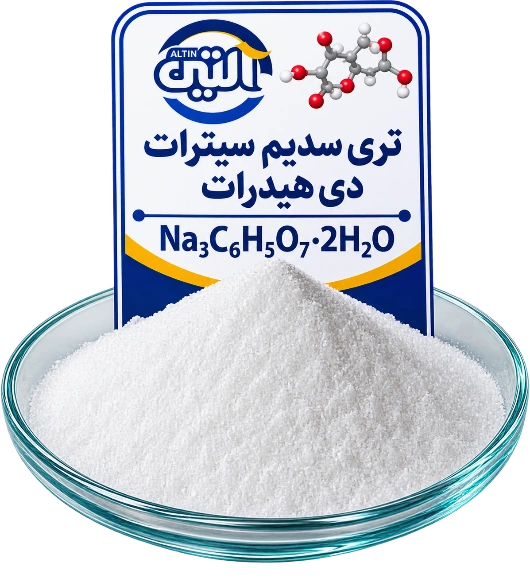
Trisodium Citrate Dihydrate is the most widely used commercial and practical form of trisodium citrate. Its chemical formula is C₆H₅Na₃O₇·2H₂O. This compound is the trisodium salt of citric acid, containing two molecules of water of crystallization.
Structure of Trisodium Citrate Dihydrate
Identification Properties
CAS Number: 6132-04-3 Molar Mass: 294.10 g/mol
Physical Properties
Appearance: Colorless crystals or white crystalline powder, practically odorless. Taste: Salty with a mildly sour taste. Melting Point: Loses its water of crystallization at approximately 150°C and decomposes at temperatures above 300°C. Solubility: Freely soluble in water.
Chemical Properties
This compound is stable and retains its properties under proper storage conditions (in a dry environment, away from moisture). Its aqueous solution exhibits buffering properties and acts as a weak base. Due to the presence of carboxylate groups, it has good chelating properties toward divalent and trivalent metal ions, particularly calcium, magnesium, and iron. It is also non-toxic, biodegradable, and environmentally friendly.
Main Applications
Food Industry: Acidity regulator, buffering agent, emulsifier, and stabilizer, particularly in processed cheese, beverages, and dairy products.
Pharmaceutical and Medical Industry: Anticoagulant in blood collection tubes and blood transfusions, buffering agent in injectable and oral formulations, and alkalizing agent.
Other Applications: Chelating agent in detergents, buffering agent in cosmetics and personal care products, and use in laboratory applications.